
One constant about technology is that it changes rapidly. Technology tools that were once staples, like Internet Explorer and Adobe Flash, age out. New technology tools replace those that are obsolete. Discontinued technology can leave computers and networks vulnerable to attacks.
While older technology may still run fine on your systems, that doesn’t mean that it is okay to use. One of the biggest dangers of using outdated technology is that it can lead to a data breach.
Outdated software and hardware no longer receive vital security updates. Updates often patch newly found and exploited system vulnerabilities. No security patches means a device is a sitting duck for a cybersecurity breach.
Approximately 1 in 3 data breaches are due to unpatched system vulnerabilities.
Another problem with using discontinued technology is that it can leave you behind. Your business can end up looking like you’re in the stone ages to your customers and they can lose faith and trust.
Important reasons to keep your technology updated to a supported version are:
- Reduce the risk of a data breach or malware infection
- Meet data privacy compliance requirements
- To keep a good reputation and foster customer trust
- To be competitive in your market
- To mitigate hardware and software compatibility issues
- To enable employee productivity
Older systems are clunky and get in the way of employee productivity. If you keep these older systems in use, it can lead to the loss of good team members due to frustration.
49% of surveyed workers say they would consider leaving their jobs due to poor technology.
The following is a list of outdated technology tools that you should replace as soon as possible. Are any of these still in use on your home computer or within your business?
Get Rid of This Tech Now If You’re Still Using It
Internet Explorer
Internet Explorer (IE) used to be the number one browser in the world. Over time, Google Chrome and other browsers edged it out. This includes its replacement (Microsoft Edge).
Microsoft began phasing out IE with the introduction of Microsoft Edge in 2015. In recent years, fewer applications have been supporting use in IE. The browser lost all support beginning on June 15, 2022.
Adobe Flash
Millions of websites used Adobe Flash in the early 2000's. However, other tools can now do the animations and other neat things Flash could do. This made the tool obsolete and Adobe ended it.
The Adobe Flash Player lost all support, including security updates, as of January 1, 2021. Do you still have this lingering on any of your computers? If so, you should uninstall the browser plugin and any Flash software.
Windows 7 and Earlier
Windows 7 was a very popular operating system but it has now gone the way of the dinosaur. The replacements of Windows 10 and Windows 11 are now in widespread use. The Windows 7 OS lost support on January 14, 2020.
While it may still technically run, it’s very vulnerable to hacks. Microsoft Windows OS is also a high-value target for hackers. You can be sure they are out there looking for systems still running this obsolete version of Windows.
MacOS 10.14 Mojave and Earlier
Due to the cost of iMacs and MacBooks, people tend to hang onto them as long as possible. Once these devices get to a certain point, updates no longer work. This leaves the hardware stuck on an older and non-supported macOS version.
If you are running macOS 10.14 Mojave or earlier, your OS is no longer supported by Apple and you need to upgrade.
Oracle 18c Database
If your business uses Oracle databases, you may want to check your current version. If you are running the Oracle 18C Database, you are vulnerable. Breaches can easily happen due to unpatched system vulnerabilities.
The Oracle 18C Database lost all support in June of 2021. If you have upgraded, then you will want to keep an eye out for another upcoming end-of-support date. Both Oracle 19C and 21C will lose premiere support in April of 2024.
Microsoft SQL Server 2014
Another popular database tool is Microsoft’s SQL. If you are using SQL Server 2014, mainstream support has already ended. In July of 2024, all support (including security updates) will stop.
This gives you a little more time to upgrade before you’re in danger of not getting security patches. However, it is better to upgrade sooner rather than later. This leaves plenty of time for testing and verification of the upgrade.
Get Help Upgrading Your Technology & Reducing Risk
Upgrades can be scary when everything that you have been using has been running great. You may be afraid that a migration or upgrade will cause issues. We can help you upgrade your technology smoothly and do thorough testing afterward. Schedule a technology review today by calling us at (860) 577-8060 or using our convenient contact form.
There is a reason why phishing is usually at the top of the list for security awareness training. For the last decade or two, it has been the main delivery method for all types of attacks. Ransomware, credential theft, database breaches and more launch via a phishing email.
Why has phishing remained such a large threat for so long? Because it continues to work. Scammers evolve their methods as technology progresses. For example, they use AI-based tactics to make targeted phishing more efficient.
If phishing didn’t continue working, scammers would move on to another type of attack. That hasn’t been the case. People continue to get tricked. They open malicious file attachments, click on dangerous links and reveal passwords.
In May of 2021, phishing attacks increased by 281%. Then in June, they spiked another 284% higher.
Studies show that as soon as 6 months after training, phishing detection skills wane. Employees begin forgetting what they have learned and cybersecurity suffers as a result.
Want to give employees a “hook” they can use for memory retention? Introduce the SLAM method of phishing identification.
What is the SLAM Method for Phishing Identification?
One of the mnemonic devices known to help people remember information is the use of an acronym. SLAM is an acronym for four key areas of an email message to check before trusting it.
These are:
S = Sender
L = Links
A = Attachments
M = Message text
By giving people the term “SLAM” to use, it’s quicker for them to check suspicious email. This device helps them avoid missing something important. All they need to do is use the cues in the acronym.
Check the Sender
It is important to check the sender of an email thoroughly. Often scammers will either spoof an email address or use a look-alike. People often mistake a spoofed address for the real thing.
In this phishing email below, the email address domain is “@emcom.bankofamerica.com.” The scammer is impersonating Bank of America. This is one way that scammers try to trick you. They put the real company’s URL inside their fake one.
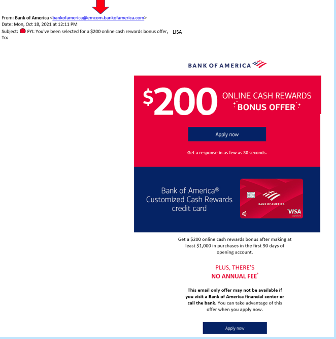
You can see that the email is very convincing. It has likely fooled many people into divulging their personal details. People applying for a credit card provide a Social Security Number, income and more.
Doing a quick search on the email address quickly reveals it to be a scam and a trap used in both email and SMS phishing attacks.
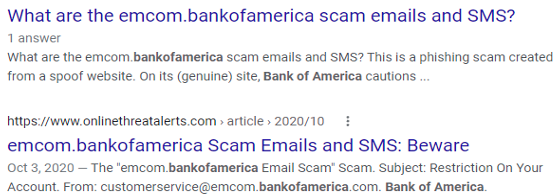
It only takes a few seconds to type an email address into Google. This allows you to see if any scam warnings come up indicating a phishing email.
Hover Over Links Without Clicking
Hyperlinks are popular to use in emails. They can often get past antivirus/anti-malware filters. Those filters are looking for file attachments that contain malware. However, a link to a malicious site doesn’t contain any dangerous code. It links to a site that does.
Links can be in the form of hyperlinked words, images and buttons in an email. When on a computer, it’s important to hover over links without clicking on them to reveal the true URL. This often can immediately call out a fake email scam.
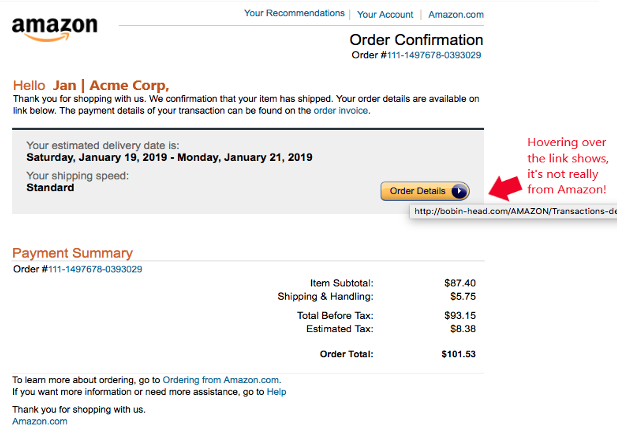
When looking at email on a mobile device, it can be trickier to see the URL without clicking on it. There is no mouse like there is with a PC. In this case, it’s best not to click the URL at all. Go to the purported site to check the validity of the message.
Never Open Unexpected or Strange File Attachments
File attachments are still widely used in phishing emails. Messages may have them attached and promise a large sales order. The recipient might see a familiar word document and open it without thinking.
It is getting harder to know what file formats to avoid opening. Cybercriminals have become savvier about infecting all types of documents with malware. There have even been PDFs with malware embedded.
Never open strange or unexpected file attachments. Use an antivirus/anti-malware application to scan all attachments before opening.
Read the Message Carefully
We have become savvier at scanning through text as technology has progressed. It helps us quickly process a lot of incoming information each day. But if you rush through a phishing email, you can miss some telltale signs that it is a fake.
Look at the phishing example posted above in the “Links” section. There is a small error in grammar in the second sentence. Did you spot it?
It says, “We confirmation that your item has shipped,” instead of “We confirm that your item has shipped.” These types of errors can be hard to spot but are a big red flag that the email is not legitimate.
Get Help Combatting Phishing Attacks
Both awareness training and security software can improve your defenses against phishing attacks. Contact us today at (860) 577-8060 or use our contact form and we will be happy to discuss your email security needs.
Large companies and small businesses are seeing an ever-growing number of cyber threats that attack their endpoints. Their regular endpoint security software may fail against advanced cyberattacks and render them ineffective and outdated. According to a report by Ponemon Institute, 2018 placed a destructive hit on 64% of organizations due to endpoint attacks. Read more
You have completed your annual phishing training. This includes teaching employees how to spot phishing emails. You’re feeling good about it. That is until about 5-6 months later. Your company suffers a costly ransomware infection due to a click on a phishing link.
You wonder why you seem to need to train on the same information every year. You still suffer from security incidents. The problem is that you’re not training your employees often enough.
People can’t change behaviors if training isn’t reinforced. They can also easily forget what they have learned after several months go by.
How often is often enough to improve your team’s cybersecurity awareness? It turns out that training every four months is the “sweet spot.” This is when you see more consistent results in your IT security.
Why Is Cybersecurity Awareness Training Every 4-Months Recommended?
Where does this four-month recommendation come from? There was a study presented at the USENIX SOUPS security conference recently. It looked at users’ ability to detect phishing emails versus training frequency. It looked at training on phishing awareness and IT security.
Employees took phishing identification tests at several different time increments:
- 4-months
- 6-months
- 8-months
- 10-months
- 12-months
The study found that scores were still good four months after their training. Employees were still able to accurately identify and avoid clicking on phishing emails. However, after 6-months, their scores started to get worse. Scores continued to decline as the months passed after their initial training.
To keep employees well prepared, they need training and refreshers on security awareness. This will help them to act as a positive agent in your cybersecurity strategy.
Tips on What & How to Train Employees to Develop a Cybersecure Culture
The gold standard for security awareness training is to develop a cybersecure culture. This is one where everyone is cognizant of the need to protect sensitive data as well as avoid phishing scams and keep passwords secured.
This is not the case in most organizations. According to the 2021 Sophos Threat Report, one of the biggest threats to network security is a lack of good security practices.
The report states the following:
“A lack of attention to one or more aspects of basic security hygiene has been found to be at the root cause of many of the most damaging attacks we've investigated.”
Well-trained employees significantly reduce a company’s risk. They reduce the chance of falling victim to any number of different online attacks. To be well-trained doesn’t mean you need to conduct a long day of cybersecurity training. It is better to mix up the delivery methods.
Here are some examples of engaging ways to train employees on cybersecurity. You can include these in your training plan:
- Self-service videos that get emailed once per month
- Team-based roundtable discussions
- Security “Tip of the Week” in company newsletters or messaging channels
- Training session given by an IT professional
- Simulated phishing tests
- Cybersecurity posters
- Celebrate Cybersecurity Awareness Month in October
When conducting training, phishing is a big topic to cover. However, it’s not the only one. Here are some important topics that you want to include in your mix of awareness training.
Phishing by Email, Text & Social Media
Email phishing is still the most prevalent form. SMS phishing (“smishing”) and phishing over social media are both growing. Employees must know what these look like so that they can avoid falling for these sinister scams.
Credential & Password Security
Many businesses have moved most of their data and processes to cloud-based platforms. This has led to a steep increase in credential theft because it’s the easiest way to breach SaaS cloud tools.
Credential theft is now the #1 cause of data breaches globally. This makes it a topic that is critical to address with your team. Discuss the need to keep passwords secure and the use of strong passwords. Also, help them learn tools like a business password manager.
Mobile Device Security
Mobile devices are now used for a large part of the workload in a typical office. They’re handy for reading and replying to an email from anywhere. Most companies will not even consider using software these days if it doesn’t have a great mobile app.
Review security needs for employee devices that access business data and apps such as securing the phone with a passcode and keeping it properly updated.
Data Security
Data privacy regulations are something else that has been rising over the years. Most companies have more than one data privacy regulation requiring compliance.
Train employees on proper data handling and security procedures. This reduces the risk that you will fall victim to a data leak or breach that can end up in a costly compliance penalty.
Need Help Keeping Your Team Trained on Cybersecurity?
Take training off your plate and train your team with cybersecurity professionals. We can help you with an engaging cybersecurity awareness training program that helps your team change their behaviors to improve cyber hygiene. You can reach us at (860) 577-8060 or use our convenient contact form.
Insider Threats have been on the rise lately and companies find it hard to figure out the best security service or strategy that will thwart them. According to research, incidents associated with insider attacks had a 44% rise in the last two years. Employees contribute to about 40% of these threats with easy access to sensitive information. Business owners must deal with such incidents by wielding weapons as strong as those used against external attackers. Read more
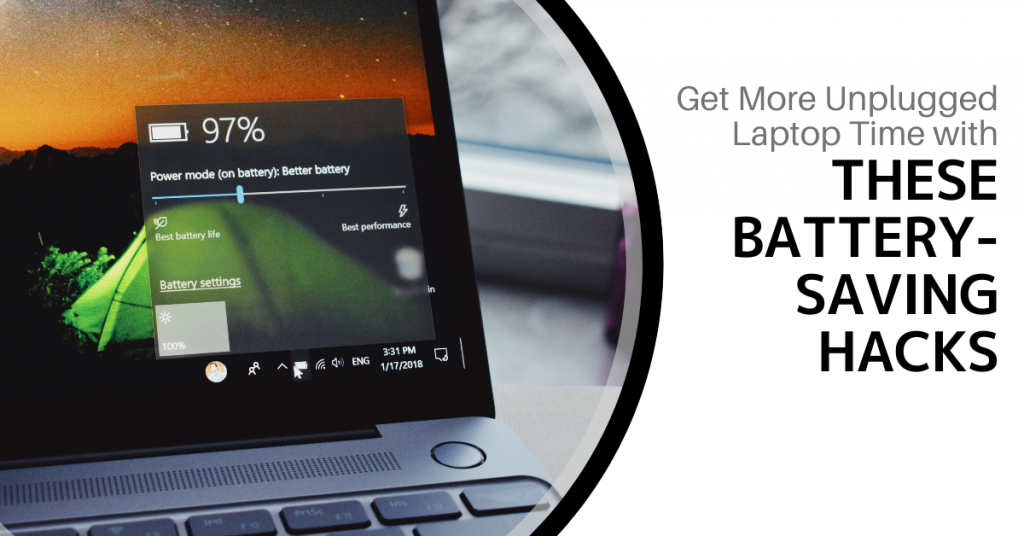
One of the big draws of a laptop computer is that you can use it anywhere. You don’t need to have it plugged in all of the time because it has an internal battery.
Your laptop may start out with several hours of battery life when you first buy it. However, the lifespan can get shorter as time goes by and battery health takes a hit. Sometimes this can be due to a lack of PC maintenance. Other times, it's due to the environments that the laptop is subject to (such as a hot car).
Seeing your laptop’s battery capacity shrink can be frustrating. There are several things that you can do to increase the time you can go without needing to plug it in.
Lower the Display Brightness
The brighter your display means the more battery power it’s taking. Have you ever hit the automated low battery mode on a laptop? Then you know you immediately notice a difference in brightness. This is because that setting turns down the brightness. It's one of the ways to reduce battery consumption.
You can turn down the brightness of your screen in your display settings. You can also use the brightness keys that are usually in the top row of keys on a laptop keyboard.
Reduce PC Battery Use in Power/Sleep Settings
Here is one way to increase the time that you can use your unplugged laptop without a power source. Adjust some of its power and sleep settings.
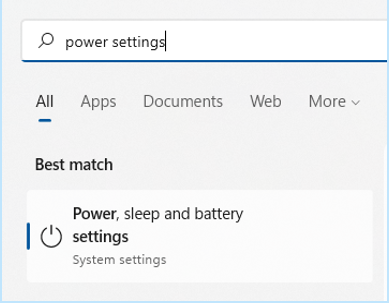
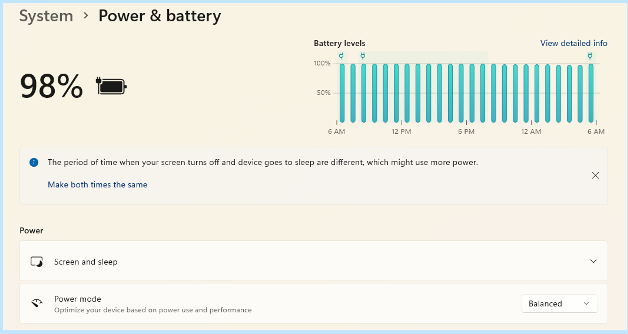
If you’re using Windows, open the search on the Task Bar. Type in “power settings." This directs you to the power, sleep and battery settings in your system settings.
Look for any tips at the top for increasing battery longevity. This includes making the time your screen goes dark after inactivity and the time it goes to sleep the same.
Then review the settings (such as Screen, Sleep and Power mode). Find the ones that will reduce your PC’s battery consumption. This will extend the time that you can go without a new charge.
Enable Battery-Saver Mode
You don’t need to wait until your PC hits 10% for it to go into battery-saver mode. You can control this and enable it yourself in your system settings.
Do you know you’re going to be without a power source for a while? Put your PC in power-saver or battery-saver mode right away so that you can extend the charge as long as possible.
Use the Manufacturer’s Calibration Tool
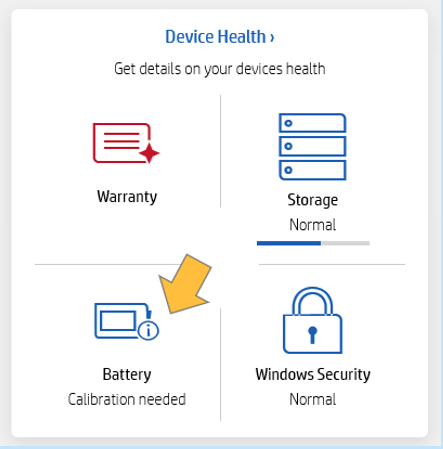
Manufacturers will have their own PC maintenance tools installed that you can use for battery calibration. Sometimes calibrating the battery can correct an issue with a battery life. This is especially true if life has gotten shorter than when you first purchased your laptop.
Look for a manufacturer’s built-in maintenance app. It will usually be on the Task Bar unless you have hidden it. When you open that, you may find that you need to do a calibration or other maintenance task.
Get a Computer Tune-up
If you have processes running in the background, it can sap your battery life. Processes that aren't needed can often run anyhow. Getting a computer tune-up from your IT provider can solve a lot of different issues. This includes computers that get sluggish and battery life.
Consider Using Microsoft Edge Browser for Its Efficiency Settings
If you keep a lot of browser tabs open while you’re working on your PC. They could be sapping your battery power.
Consider trying Microsoft’s Edge browser. It has been gaining in popularity ever since it incorporated the Chromium engine. This is same one Chrome uses.
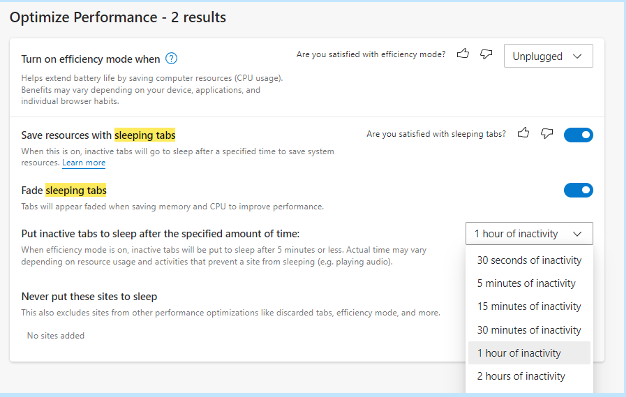
The browser has several power-saving features that you can enable in your settings. Search “sleeping tabs” in Edge settings to find these. They include:
- Enable efficiency mode (choose from the available options).
- Enable Sleeping Tabs and fade them when asleep.
- Choose when you would like to put inactive browser tabs to sleep to conserve power.
Turn Off Unnecessary Apps Hogging Power
Check the apps that are running on your PC in the Task Manager. Do you really need them all to run when you’re unplugged and trying to conserve battery power?
Often processes that aren’t 100% necessary all the time will be running. These include an update service or cloud storage syncing app. Close the apps that you don’t need to use at that time to lengthen battery life.
Keep Your PC Out of Too Much Heat or Freezing Temps
Both excess heat and freezing temperatures can be bad for a computer. This includes shortening the battery life.
You should never leave your laptop in a car on a hot day or when it’s freezing outside. Also, it might not seem particularly hot to you but if it’s sunny the inside of a vehicle can heat up pretty quickly. Be aware of the temperature extremes that your laptop is subject to.
Looking for a PC Tune-Up or Battery Replacement?
We can help you with a full system tune-up or a laptop battery replacement if needed. Don’t struggle when you can have that fixed in no time! Give us a call today at (860) 577-8060 or fill out our contact form and let’s chat.
To increase the beneficiaries of their security services, Microsoft introduced Defender for Individuals. This new security tool will protect computers and mobile phones from the ever-growing rate of cyberattacks. Microsoft 365 subscribers with either personal or family subscriptions will enjoy this new addition across different devices: iOS, macOS, Windows and Android.Read more
“Hybrid office” is the new buzzword you will hear in business discussions. It’s the mix of having employees both working at the office and working from home. This has become more than a buzzword and is now the reality for many companies.
There was a survey of employees with remote-capable jobs. The survey found that as of February of 2022, 42% of them were working a hybrid schedule and 39% were working from home full time.
The global pandemic brought on this hybrid office transition. It forced companies to operate with teams that could no longer safely come to the office. During this time, employers and employees experienced the benefits of hybrid work firsthand.
These benefits of remote teams included cost savings for both workers and employers. It also allowed the company to operate with more flexibility. Improving worker morale was another advantage.
Many employers feared that remote work would tank productivity. It actually increased in many circumstances.
63% of high-growth companies use a “productivity anywhere” hybrid work approach.
In order for hybrid teams to be productive, they need to stay connected. No matter where they work, the right technology tools should enable them.
One of the leaders in this space has been Microsoft. The company plans to add several exciting updates this year. These updates will provide more tools for companies to enable their hybrid teams.
Here are some of the ways that you can use Microsoft 365 to optimize a productive hybrid office. Please note that some of these features are already out and others should release later this year.
1. Microsoft Teams & Expanded Features
Microsoft Teams is much more than a team messaging app. The application combines the best features of virtual video meetings and messaging channels. It brings them together into a platform designed to be a secure online work hub.
MS Teams has come a long way in the last five years and the company continues to add more features to enable hybrid offices. Some of the recent feature updates include:
- The ability to do webinar registration
- Presenter modes that provide a more professional virtual presence
- Increased security through features like smart links and smart attachments
- A full business VoIP phone system add-on
- The addition of a “metaverse” component called Mesh for Teams

New Meeting Options for RSVP in Outlook
One of the challenges when everyone isn’t working in the same place is how to know when to “clock in” and “clock out.” You may also wonder how to let colleagues know whether you are working at home next week or in the office.
To help hybrid teams better coordinate, Outlook is getting an update. It will allow users to RSVP to meetings. This can let team members know whether they are attending virtually or in person.
Better Framing for More Engaging Meetings
One thing that can distract from the purpose of a meeting is someone’s background at home. Positioning of the camera can also be problematic. One person might have their face taking up 80% of the video screen. Another may only take up 20% because they’re sitting farther away from their PC’s camera.
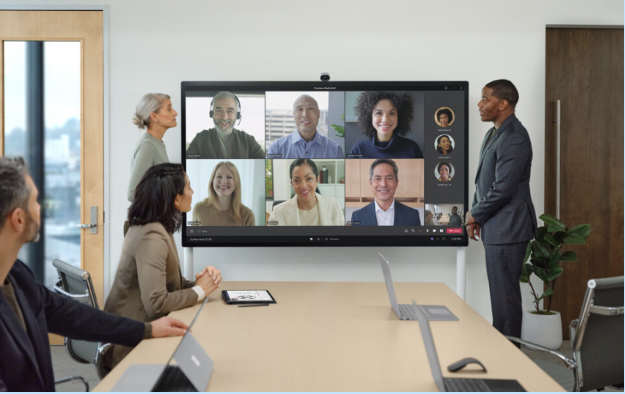
A new Surface Hub 2S Smart Camera will allow for better face framing. This will affect when people are meeting virtually in Microsoft Teams. Features include adjusting the room view so people’s faces will be clearer as well as having more consistent sizing.
The video display will also automatically adjust as people join or leave a physical room.
Get Better Control of Your Video Using PowerPoint to Present
People often share a screen in a video call and present a PowerPoint presentation. It can be difficult to keep everyone as engaged as when you’re presenting in person.
For example, in person you can maintain eye contact. People can clearly see your facial expressions as you emphasize various things. That is not always the case when presenting virtually. The app may push your video feed into a tiny box.
There is a new upcoming feature for Teams called Cameo. It will allow you to seamlessly integrate PowerPoint with MS teams. You can decide exactly how you want your video feed to appear in relation to your presentation.
Another addition is Recording Studio. This new feature for PowerPoint allows you to record professional-looking on-demand videos. You can do it right inside the app.
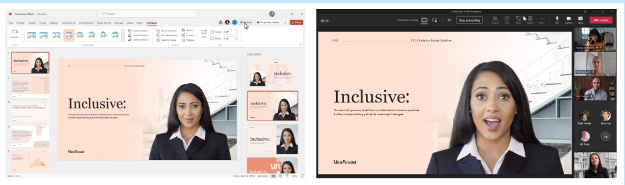
Cameo in PowerPoint & MS Teams
Get Help With Your Presentation Skills
Microsoft has poured a lot of AI capabilities into Microsoft 365 over the last several years. One that will soon help you deliver better virtual presentations is Speaker Coach.
This is a private and personalized coach. It can help you hone your presentation skills. This improves your switch to the differences between presenting online versus in person.
Some of the feedback it can provide include:
- Use of repetitive language
- Use of filler words (Ummm)
- Speaking pace
- Pausing for input
- Intonation
- Speaker overlaps
- And more
Ask Us About Improving Your Hybrid Office Capabilities with Microsoft 365
Microsoft 365 has a ton of helpful features. However, it does help to have an expert guide to help you navigate these capabilities. Contact us at (860) 577-8060 or via our convenient contact form today to set up a chat about how Microsoft 365 can help your business grow.
The security of IT services has been reduced over the years. This is due to traditional authentication methods like usernames and passwords. While this has been considered the best security strategy for decades, the increased susceptibility to cyber-attacks means it is time to switch lanes. Passwordless authentication is one of the go-to security options in recent times. According to research in 2021, it has positively impacted the security of many companies in the U.S. and Canada. Why is it creating such a buzz?Read more
Credential theft is now at an all-time high and is responsible for more data breaches than any other type of attack.
With data and business processes now largely cloud-based, a user’s password is the quickest and easiest way to conduct many different types of dangerous activities.
Being logged in as a user (especially if they have admin privileges) can allow a criminal to send out phishing emails from your company account to your staff and customers. The hacker can also infect your cloud data with ransomware and demand thousands of dollars to give it back.
How do you protect your online accounts, data and business operations? One of the best ways is with multi-factor authentication (MFA).
It provides a significant barrier to cybercriminals even if they have a legitimate user credential to log in. This is because they most likely will not have access to the device that receives the MFA code required to complete the authentication process.
WHAT ARE THE THREE MAIN METHODS OF MFA?
When you implement multi-factor authentication at your business, it’s important to compare the three main methods of MFA and not just assume all methods are the same. There are key differences that make some more secure than others and some more convenient.
Let’s take a look at what these three methods are:
SMS-BASED
The form of MFA that people are most familiar with is SMS-based. This one uses text messaging to authenticate the user.
The user will typically enter their mobile number when setting up MFA. Whenever they log into their account, they will receive a text message with a time-sensitive code that must be entered.
ON-DEVICE PROMPT IN AN APP
Another type of multi-factor authentication will use a special app to push through the code. The user still generates the MFA code at login. Rather than receiving the code via SMS, it’s received through the app.
This is usually done via a push notification and it can be used with a mobile app or desktop app in many cases.
SECURITY KEY
The third key method of MFA involves using a separate security key that you can insert into a PC or mobile device to authenticate the login. The key itself is purchased at the time the MFA solution is set up and will be the thing that receives the authentication code and implements it automatically.
The MFA security key is typically smaller than a traditional thumb drive and must be carried by the user to authenticate when they log into a system.
Now, let’s look at the differences between these three methods.
MOST CONVENIENT FORM OF MFA?
Users can often feel that MFA is slowing them down. This can be worse if they need to learn a new app or try to remember a tiny security key. What if they lose that key?
This user inconvenience can cause companies to leave their cloud accounts less protected by not using multi-factor authentication.
If you face user pushback and are looking for the most convenient form of MFA, it would be the SMS-based MFA.
Most people are already used to getting text messages on their phones so there is no new interface to learn and no app to install.
MOST SECURE FORM OF MFA?
If your company handles sensitive data in a cloud platform, such as your online accounting solution, then it may be in your best interest to go for security.
The most secure form of MFA is the security key.
The security key, being a separate device altogether, won’t leave your accounts unprotected in the event of a mobile phone being lost or stolen. Both the SMS-based and app-based versions would leave your accounts at risk in this scenario.
The SMS-based is actually the least secure because there is malware out there now that can clone a SIM card which would allow a hacker to get those MFA text messages.
A Google study looked at the effectiveness of these three methods of MFA at blocking three different types of attacks. The security key was the most secure overall.
Percentage of attacks blocked:
- SMS-based: between 76 - 100%
- On-device app prompt: between 90 - 100%
- Security key: 100% for all three attack types
WHAT IS IN BETWEEN?
So, where does the app with an on-device prompt fit in? Right in between the other two MFA methods.
Using an MFA application that delivers the code via push notification is more secure than the SMS-based MFA. It’s also more convenient than needing to carry around a separate security key that could quickly become lost or misplaced.
LOOKING FOR HELP SETTING UP MFA AT YOUR COMPANY?
Multi-factor authentication is a “must-have” solution in today’s threat climate. We would be happy to discuss your barrier points and come up with a solution together to keep your cloud environment better secured.
You can reach us at (860) 577-8060 or via our contact form.